
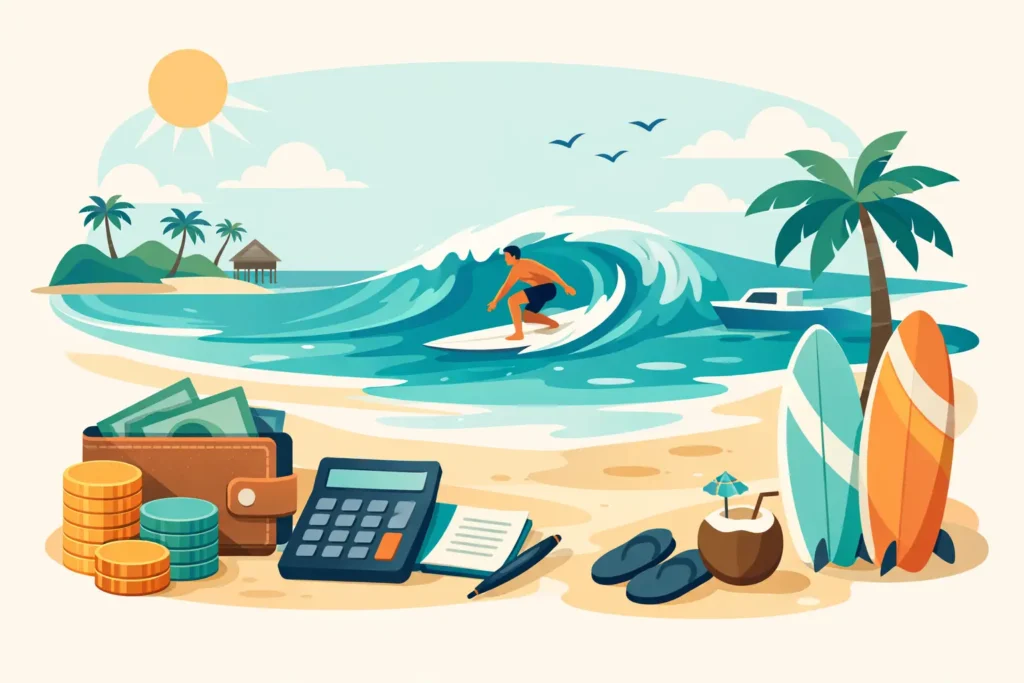
The Maldives can look like a fantasy reserved for pro surfers, overwater villas, and expense-account travelers. Then you price it out and realize the truth is more interesting – a surf trip here can be outrageously luxurious, surprisingly manageable, or somewhere in between depending on where you stay, how you chase waves, and how much comfort you want between sessions.
That is what makes a Maldives surf trip budget breakdown worth doing before you book. The same destination can swing from a lean strike mission built around local islands to a polished surf-resort week with boat transfers, guided access, and sunrise sessions at world-class breaks like Pasta Point, Chickens, and Cokes. The goal is not to find one magic number. It is to understand what drives the cost so you can spend where it matters most.
What a Maldives surf trip really costs
For most U.S. travelers, a Maldives surf trip lands in one of three budget lanes. A value-focused trip built around guesthouses on local islands and selective surf transfers can come in around $2,500 to $4,000 per person for a week, including flights. A mid-range trip with better rooms, more organized surf access, and fewer compromises often runs $4,000 to $6,500. A premium surf resort or liveaboard experience can easily start around $6,500 and move well past $10,000 depending on season, room type, and how exclusive you want the experience to feel.
That range is wide because the Maldives is not one product. It is a chain of islands with very different logistics. Staying near North Male Atoll breaks is a different budget story than booking a polished charter to reach less-crowded waves farther south.
Flights from the U.S. are usually your biggest fixed cost
If you are flying from the United States, airfare to Male is often the least flexible part of the budget. Round-trip flights commonly fall between $1,000 and $1,800 from major U.S. gateways, though peak dates can push higher. East Coast departures sometimes price a little better than smaller regional airports once you factor in connections.
This is one area where timing matters more than wishful thinking. If you are traveling during the prime surf window, especially when consistent swell draws experienced surfers toward the central atolls, cheaper fares disappear fast. Shoulder-season travel can shave a few hundred dollars off the total, but the trade-off is less certainty in conditions. That may be fine for beginners or casual surfers who want a Maldives escape with a few good sessions rather than a full chase for barrel-perfect waves.
Accommodation shapes the whole budget
When people imagine the Maldives, they usually picture luxury resorts. Those are real, and they are incredible, but they are only one version of the trip.
Guesthouses on local islands can start around $80 to $180 per night for a clean, comfortable room. They are the budget-friendly path into the islands, and for surfers who care more about wave access than polished indulgence, they can work well. The catch is that surf logistics may be more pieced together, and the overall experience is less private and less glossy than the resort version.
Mid-range hotels and surf camps generally land around $180 to $350 per night. This is often the sweet spot for travelers who want comfort, air conditioning that works, solid meals, and help coordinating surf transfers without paying full luxury-resort prices.
Surf resorts are where the number climbs fast. Expect roughly $500 to $1,500 or more per night depending on season, room category, and whether meals or surf access are included. What you are buying is not just the room. You are buying convenience, atmosphere, a polished island experience, and often easier access to nearby reef breaks.
A Maldives surf trip budget breakdown by travel style
If you want the clearest planning shortcut, think in terms of travel style rather than chasing averages.
Budget-conscious surf traveler
A week on a local island with a guesthouse, simple meals, shared boat costs, and modest daily spending can look like this: about $1,200 to $1,600 for flights booked well, around $700 to $1,200 for lodging, $300 to $700 for surf transfers and boat time, and another $250 to $500 for food, tips, and incidentals. That puts many travelers in the $2,500 to $4,000 range.
This version works best if you are flexible, willing to plan around available transfers, and not expecting resort-level amenities between sessions.
Mid-range surf-and-comfort trip
This is the version many U.S. travelers end up choosing. Flights may still run $1,200 to $1,700, but accommodations move closer to $1,400 to $2,500 for the week. Add $500 to $1,000 for organized surf access, plus meals, transfers, and extras, and the full cost often lands around $4,000 to $6,500 per person.
You get a much smoother trip here. Fewer moving parts. Better rest. Better food. Often better access to boats and surf guides, which matters when every good session feels like part of the reason you flew halfway across the world.
Premium surf resort or liveaboard trip
If your version of paradise includes polished service, uncrowded lineups, and a room or cabin that feels like part of the reward, costs rise quickly. Flights may be similar, but accommodation or charter rates can add $3,500 to $8,000 or more for a week. With premium transfers, gear needs, drinks, and tips, the total can easily push beyond $7,000 per person.
The upside is obvious. This is the Maldives at full volume – turquoise waters, warm trade winds, sunrise glass, and the kind of easy luxury that lets you focus on surfing instead of logistics.
Boats, transfers, and surf access are the hidden swing costs
This is where many budgets go sideways. Even if your room rate looks reasonable, you still need to reach the waves.
In the central atolls, boat transfers to famous breaks may be charged separately, bundled into surf packages, or shared among guests. A simple shared surf transfer can be fairly manageable, while private boat access adds up fast. If you are staying somewhere remote or transferring by speedboat or seaplane, transportation can become one of the biggest line items after airfare.
The trade-off is straightforward. Pay less, and you may have less control over when and how you reach the lineup. Pay more, and you buy convenience, flexibility, and often access to less-crowded windows at better breaks.
Food, drinks, and daily spending
Food can be modest or premium depending on where you stay. On local islands, meals may run $10 to $25 each at casual spots or guesthouses. At resorts, meal plans can help, but a la carte pricing is usually much higher. That burger by the lagoon is part lunch, part destination tax.
For a week, a budget traveler might spend $200 to $350 on food, while mid-range and resort travelers can spend $500 to $1,200 or more. Alcohol can also shift the number. Local islands have different rules than private resorts, so your spending options depend heavily on where you base yourself.
Gear, board fees, and the small costs that add up
If you bring your own boards, check airline baggage rules before you book. Board fees on long-haul routes can be painful, and not every “surf-friendly” fare is actually generous. A cheap ticket can become an expensive one once you add board bags.
Renting gear in the Maldives is possible in some areas, but serious surfers usually prefer to travel with familiar boards. Wax, reef booties, sunscreen, rash guards, travel insurance, airport snacks, and tips are not glamorous budget categories, but together they can add several hundred dollars.
Travel insurance is especially worth considering for a trip like this. Reef breaks are part of the magic, but they are not forgiving, and weather or transfer disruptions are not unusual in island destinations.
When to spend more and when to save
If surfing is the main event, spend for access before aesthetics. A slightly less glamorous room near reliable boat service often delivers more value than a beautiful stay that makes each surf session harder to reach. Wave count matters.
If this is a milestone trip, though, comfort can be part of the point. The Maldives is one of those rare destinations where a post-surf sunset, a polished beachfront dinner, and a calm lagoon morning genuinely change the experience. Saving aggressively on every line item may get you there, but it can also strip away some of what makes the destination feel timeless and magical.
The smartest budget is usually selective. Save on room category, not location. Save on fancy extras, not reliable transfers. Save by traveling with friends and sharing boat costs, not by assuming island logistics will sort themselves out cheaply.
How to build your own Maldives surf trip budget breakdown
Start with the non-negotiables: flight budget, trip length, and whether you want a local island, surf camp, resort, or liveaboard. Then estimate surf access separately instead of assuming it is included. After that, add food, domestic transfers, board fees, and a cushion for the extras that always appear once the trip is real.
A good planning rule is to build your ideal budget, then add 10 to 15 percent. In the Maldives, that buffer is not pessimism. It is realism.
If you are still deciding between styles of trip, start with the experience you want in the water. Do you want easy access to recognized breaks, guided sessions, and resort comfort, or are you happy to trade polish for a lower price and more DIY planning? That answer usually gets you closer to the right number than any generic travel estimate.
For travelers mapping out surf, stay, and island logistics in one place, Maldives Holiday Islands can help turn the dream into a plan. Spend carefully, book intentionally, and let the bigger splurges earn their place – because the best Maldives trips are not the cheapest ones, but the ones where every dollar gets you closer to the session you came for.