
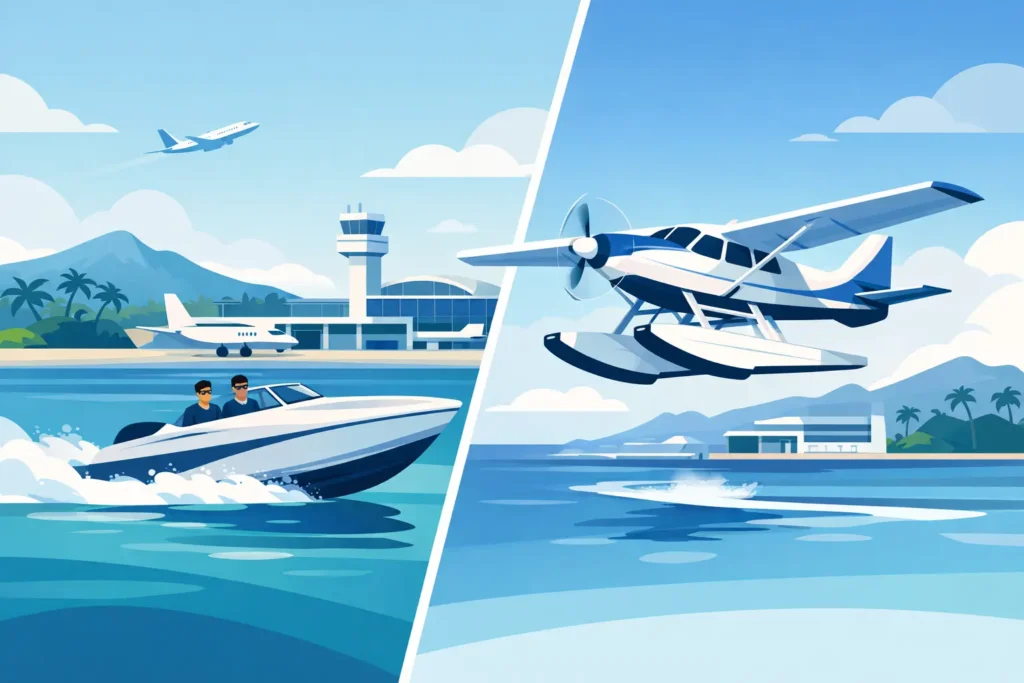
You land at Velana International Airport, step into the warm Maldivian air, and the first real vacation decision hits fast: male airport speedboat vs seaplane. It is not a small detail. Your transfer shapes the first hours of the trip, affects your budget, and sets the tone for everything that follows – from a smooth glide across turquoise water to a low-altitude flight over reef rings that look almost unreal.
For most U.S. travelers, the right choice comes down to three things: where your resort sits, how much time you want to spend transferring, and what kind of arrival you want. One option is practical, often simpler, and usually less expensive. The other is iconic, scenic, and unmistakably Maldives.
Male airport speedboat vs seaplane: the real difference
A speedboat transfer takes you directly from the airport marina to resorts within reachable distance of Male and the nearby atolls. You stay at sea level the whole way, usually boarding not long after arrival if schedules line up. It feels straightforward and easy, especially after a long international flight.
A seaplane transfer is a domestic-style air transfer on a floatplane that lands on the ocean near your resort. It serves islands farther from Male where a speedboat would be too long or impractical. The experience is part transportation, part scenic tour. You get a sweeping view of lagoons, reef edges, sandbanks, and tiny private islands scattered across the Indian Ocean.
If you are choosing purely on romance and visual payoff, seaplane wins. If you are choosing on convenience after a red-eye from the U.S., speedboat often has the edge.
When a speedboat is the better fit
Speedboat transfers work best for resorts in North Male Atoll, South Male Atoll, and a few nearby areas. Many well-known surf and dive resorts rely on them because access is fast and flexible. If your trip includes dawn surf sessions, easy access to breaks near Male, or short transfer times after a long-haul flight, this can be a smart move.
The big advantage is simplicity. You clear the airport, meet the resort team, and head to the dock. There is no separate aviation terminal, no need to wait for daylight-only operations, and often less logistical friction. If your international flight lands late in the day, a speedboat-access resort can be much easier to reach on the same day.
That matters more than many travelers expect. Seaplanes generally operate only during daylight hours, so a late arrival into Male can mean an overnight stay near the airport before flying onward the next morning. A speedboat can help you avoid burning your first Maldives night in transit.
The ride itself can be beautiful. On a calm day, you skim across bright blue water with city skyline views fading behind you and resort islands appearing ahead like green-white mirages. For shorter distances, it feels efficient and exciting.
The trade-off is comfort. If the sea is choppy, the ride can be bumpy. Travelers prone to motion sickness may find a rough speedboat less pleasant than a short flight. And if your resort is technically reachable by boat but still a long haul, the glamour can wear thin quickly.
When a seaplane is worth it
Seaplanes are the Maldives arrival fantasy for a reason. You board a small aircraft, lift off over the atolls, and watch the country reveal itself in full color – neon lagoons, dark coral patches, curling reef lines, and tiny islands surrounded by impossible shades of blue.
If your resort is in Baa Atoll, Raa Atoll, or another farther-flung region, a seaplane may be the fastest and most practical route. It also opens up access to resorts known for a more remote, castaway feel. If you are chasing a high-end honeymoon, a premium dive escape, or that detached-from-the-world sensation, seaplane access often comes with the territory.
There is also a strong emotional case for it. The Maldives is one of those destinations where the journey can become part of the memory. A seaplane arrival feels cinematic. For many travelers, it is the moment the trip stops being a plan and starts feeling real.
Still, this option asks for flexibility. Schedules are coordinated around resort arrivals and departures, weather conditions, and daylight. Waiting a few hours at the seaplane terminal is not unusual. After a long international itinerary from the U.S., that extra layer can feel either magical or mildly exhausting depending on your energy level.
Cost, timing, and what travelers often miss
In the male airport speedboat vs seaplane debate, price is one of the biggest separators. Speedboats are usually less expensive than seaplanes, sometimes by a meaningful margin for couples or families. If you are already stretching for an overwater villa, diving package, or surf-guiding add-on, transfer savings can free up budget for experiences that matter more once you arrive.
Travel time is more nuanced. For nearby resorts, speedboat is often quicker door to door. For distant resorts, seaplane can dramatically cut transfer time compared with a long ocean run. But that does not always mean you arrive earlier. Seaplane check-in, waiting windows, and schedule coordination can extend the total journey.
This is why quoted transfer duration does not tell the full story. A 35-minute seaplane flight may still involve a longer overall transit block than a 45-minute speedboat, depending on your arrival time and resort handling.
Luggage can be another hidden factor. Seaplanes typically enforce stricter baggage limits than speedboats. If you are traveling with dive gear, camera equipment, or multiple large suitcases for a long luxury stay, ask about excess luggage fees before booking. Surfers should be especially careful. Board transport is not just about weight but also dimensions, and policies vary by operator and resort.
Comfort and experience on arrival
There is no single winner here because comfort means different things to different travelers.
If you hate small aircraft or want the least complicated handoff possible, speedboat feels easier. You can stay closer to the water, avoid aviation logistics, and often get moving faster. Families with young kids sometimes prefer that directness, especially when timing is tight.
If you are chasing spectacle, seaplane is hard to beat. The aerial approach gives you a map-like view of the atolls that you will never get from the boat. For photographers, honeymooners, and first-time Maldives visitors, that alone can justify the extra cost.
There is also the arrival style at the resort. Speedboats usually pull right up to the jetty, which can feel smooth and polished. Seaplanes land offshore, and guests transfer to a small boat for the final approach. That extra step is part of the charm for some and one more logistical wrinkle for others.
Best choice for surfers, divers, and active travelers
For surf trips, speedboat-access resorts often make a lot of sense. Many breaks near Male are easy to reach, and less transfer time means more time in the water. If your goal is efficient access to named spots and a packed itinerary, speedboat can line up beautifully with that plan.
For dive-focused trips, it depends on where the marine action is centered. If you are heading to a remote atoll for manta rays, shark channels, or standout visibility away from busier zones, a seaplane may be the price of admission to a more exclusive underwater playground. In that case, the transfer is not a hassle – it is what gets you to the good stuff.
If your vacation blends luxury downtime with activity, ask yourself a simple question: do you want your wow moment in the sky or on the island? Some travelers want to start snorkeling, spa-hopping, and sunset-cruising as soon as possible. Others want the transfer itself to feel like a headline experience.
How to decide before you book
The smartest move is to choose the resort first with transfer reality in mind, not as an afterthought. If you already know you want short transit, late-day arrival flexibility, and a lower total bill, focus on speedboat-access islands. If you want a more remote resort and are happy to pay for a dramatic entrance, build around a seaplane property.
Also look at your international flight schedule. This is where otherwise great plans can go sideways. A resort may look perfect, but if your inbound flight lands too late for same-day seaplane service, the first night changes shape fast.
For travelers planning with Maldive Holiday Islands in mind, the best itineraries usually start with the experience goal: surf nearby reef breaks, dive deeper into remote atolls, or settle into a luxury island that feels gloriously far from everything. Once that is clear, the transfer choice gets much easier.
The Maldives rewards the right kind of planning. Pick the transfer that matches your energy, your budget, and the kind of arrival you want to remember. Then let the turquoise water do the rest.